


20 August 2026– Scientists are turning to an unlikely predator in an effort to tackle the spread of the invasive blue crab in the Adriatic, while a recent discovery in Croatia has raised fresh concerns about the species reaching new areas
Researchers from the University of Bologna are working on a project that aims to release around 160,000 young common octopuses into the Adriatic as part of an effort to reduce blue crab populations, Phys.org writes.
The blue crab, native to the Atlantic coast of North America, has become increasingly widespread in the Mediterranean. It is already well established in parts of Croatia, particularly around the Neretva River, where its preference for brackish waters and muddy seabeds provides favourable conditions.
The species is a fast reproducer and feeds on a range of native organisms, including shellfish such as mussels. Its growing population has raised concerns among fishermen, aquaculture producers and environmental authorities over its potential impact on native ecosystems.
Blue crabs detected near Lastovo
The species has now also been detected in the waters of the Lastovo Archipelago Nature Park, where four blue crabs were recently found entangled in a floating fishing net.
Three specimens survived and were examined – two females and one male.
The discovery is significant because blue crabs had not previously been recorded as part of the Lastovo Archipelago ecosystem.
According to the Nature Park, the net did not belong to local fishermen, raising the possibility that the crabs may have arrived after drifting from other areas.
Authorities have stressed that this was an isolated discovery, and there is currently no evidence that the blue crab has established a population within the protected area.
The finding has nevertheless prompted increased attention, with the public and fishermen encouraged to report any further sightings so that authorities can monitor the situation.
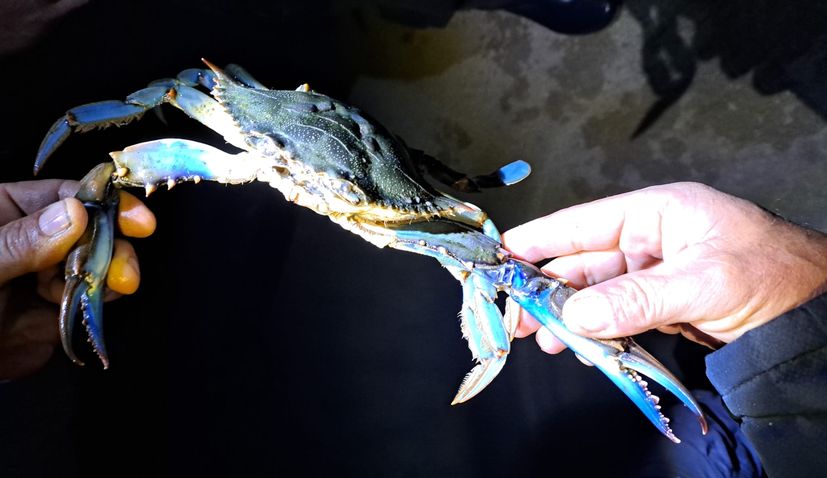
(Photo credit: Bruna Đuković)
Octopuses as a natural solution
Meanwhile, researchers in Italy are investigating whether the common octopus could provide a natural way of reducing blue crab numbers.
The Octo-Blu project, supported by the Emilia-Romagna regional government, involves raising young octopuses in controlled conditions before releasing them into the Adriatic.
Around 80,000 young octopuses had already been released by June, with a further 80,000 planned by the end of August.
Researchers are creating artificial underwater shelters from materials including cement and clay to provide protection for the young octopuses after release.
The blue crab has caused particularly serious problems for shellfish farming in northern Italy, where it feeds on clams and other shellfish. Regional authorities in Emilia-Romagna have estimated losses of almost €17 million since 2022, while nationwide losses have been estimated at around €200 million by agricultural and fisheries organisations.
Scientists caution, however, that octopuses are unlikely to provide a complete solution. Blue crabs can thrive in shallow, warm and muddy lagoon environments where octopuses are less common.
Researchers are therefore also examining other native predators, including sea bass and eels, as potential tools in managing the invasive species.
The latest discovery near Lastovo highlights the importance of monitoring the blue crab as it continues to expand its range in the Adriatic, particularly in environmentally sensitive and protected areas.
Source: www.croatiaweek.com





One Comment